
Does Duolingo offer the biblical languages?
Does Duolingo have biblical Greek and Hebrew? Short answer: no. But if you are interested in an app similar to Duolingo (in some ways) that does teach you to read the Bible in its original languages, keep reading!
Duolingo does have modern Greek and modern Hebrew, but these are not the same as biblical Greek and biblical Hebrew. The Greek and Hebrew spoken in biblical times were very different from what is spoken now. So if you want to read the Bible in its original languages, you’ll need to study the ancient versions of the languages.
In 2015, I was studying linguistics for Bible translation at Dallas International University. Walking the campus, I had an ah-ha moment. Language learning apps like Duolingo and Rosetta Stone made the English language (and many other languages) accessible to the entire world. They put world-class learning tools in the hands of every person with a smartphone. And yet no similar tool existed for learning the biblical languages.
How was it possible that there was no software for learning the original languages of the most important text in history? The resources for learning these languages should be the best in the world, but instead, they were lagging far behind.
Biblical translators and pastors who don’t speak English have not had a good way to learn the biblical languages. On top of this, many seminary students are frustrated by their lack of progress in reading Greek and Hebrew. And for parents who want to teach their kids these languages, there weren’t many kid-friendly resources at all. And so, I got to work. I started developing a curriculum using the best scientific insights into language learning. I put together a crew to film hundreds of videos in Israel illustrating biblical vocabulary. And in 2020, Biblingo was officially launched.

Walking on campus – the author of this article probably
Duolingo for the Biblical Languages
Similarly to Duolingo, Biblingo is built on the best insights from the science of second language acquisition. It incorporates many of the same science-backed features that make Duolingo effective, but with a key difference:
Duolingo is designed to teach you to converse in modern-day languages. Biblingo is designed to help you read the biblical text in its original Greek and Hebrew as quickly and effectively as possible.
There are three strategies that Biblingo shares with Duolingo that make these two platforms particularly effective:
- Focus on using the languages
- Keeping up your motivation
- Personalizing your learning experience
Strategy #1: Focus on using the languages
To know a language is to be able to use a language. If you are reading this, you know English because you can use the language to understand this text.
Language learning is all about learning to use the language meaningfully, and this takes practice. You have to practice making and hearing the sounds of the language, recognizing the words of the language, and forming sentences in the language.
Both Duolingo and Biblingo provide hours and hours worth of engaging practice exercises, so that the language you are learning eventually becomes second-nature to you–just like you are reading this text and thinking about its meaning without having to consciously think about the sounds, word meanings, and sentence structures in English.
Through repetitive practice, you will soon internalize the language, so that it becomes a part of you and you can begin to think in the language.
Strategy #2: Sustaining motivation
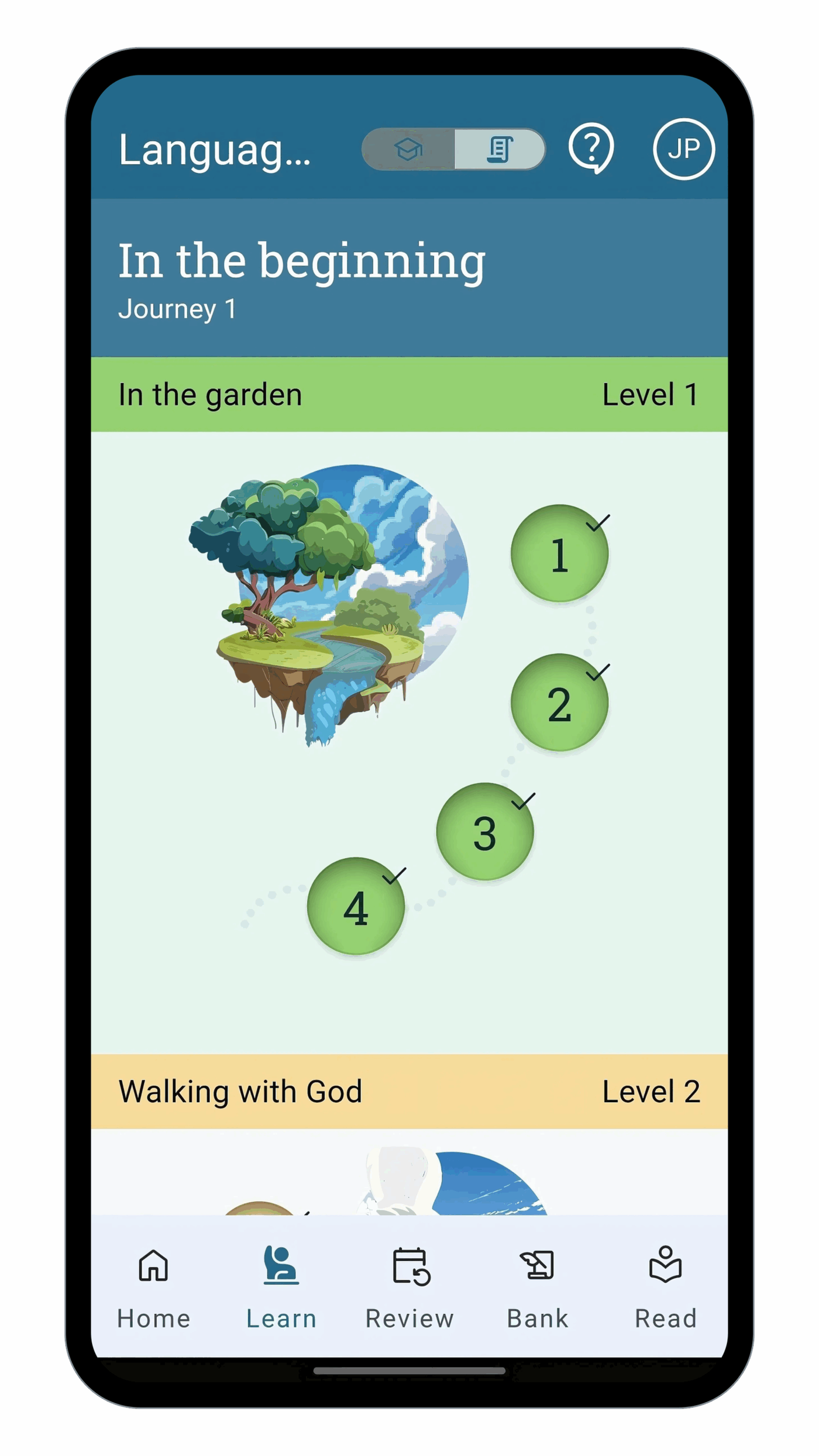
Duolingo is known for how it has made language learning fun. This is an overlooked area of language learning, but it is essential to learning a language successfully. The material and learning environment have to be engaging enough to sustain motivation.
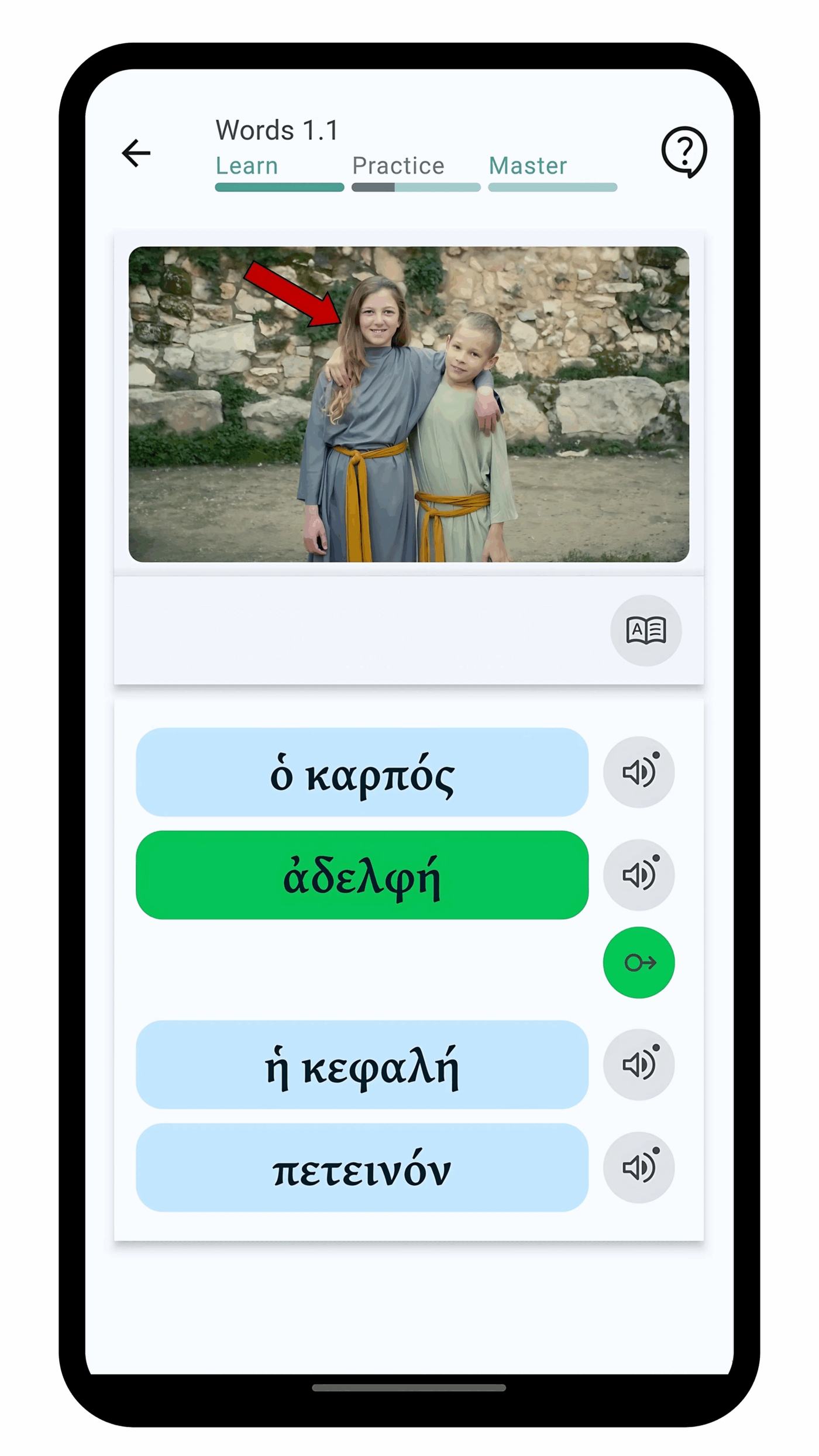
The interactive practice exercises in Duolingo and Biblingo help to engage the student in meaningful practice. This is done through the use of pictures and graphics in Duolingo and varying the type of exercise (multiple choice, matching, typing, etc.). In Biblingo, thousands of pictures and videos of reconstructed scenes from the biblical world engage the learner – similar to how a child would have learned these ancient languages. These visual aids are also paired with reading, listening, speaking, and typing exercises to foster learning and keep the student engaged.
Duolingo’s learning environment really shines in its ability to sustain motivation. Your learning journey is gamified through earning points, collecting gems, and obtaining badges. Motivational features such as a weekly leaderboard, the ability to follow friends, and a streak counter help to make sure students are engaging in daily practice of the language they are learning. Biblingo also utilizes similar gamification features (though not as heavily as Duolingo, see below). You can earn points, keep track of your learning streak, and learn with others in a cohort (available in the accelerator plan). Both apps make consistent practice enjoyable and rewarding.
Strategy #3: Personalized learning
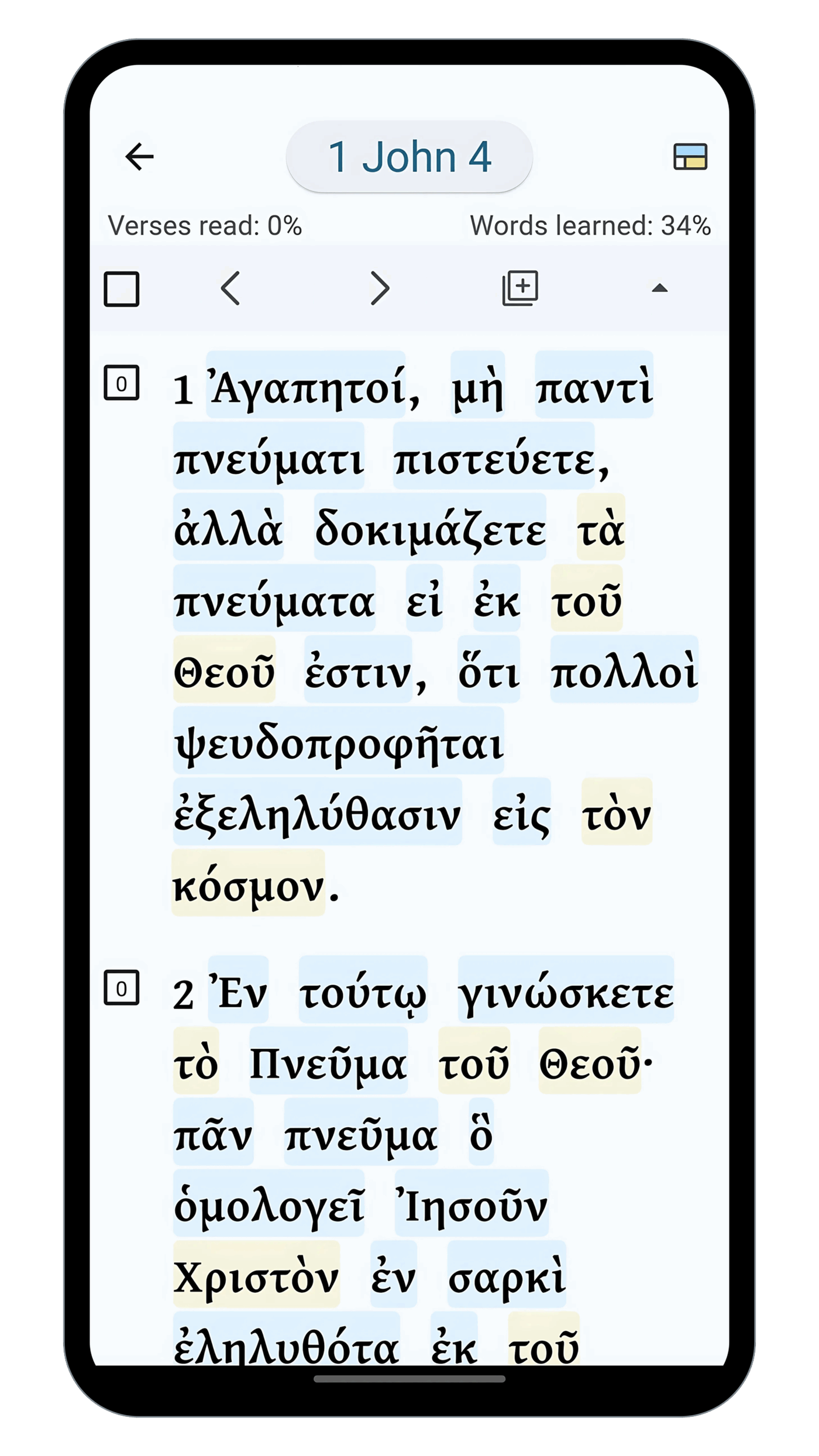
One of the most important things in learning any language is practicing with material on your level. Both Duolingo and Biblingo keep track of your progress and provide you with exercises and words to learn that are based on your own learning proficiency.
Because Biblingo focuses especially on reading, it also offers graded reading material starting early in the lessons so that you can learn to read through texts on your level. This is crucial for developing fluency in the language, because if the material is too hard, you will not be able to focus on the meaning of the text you are reading. Personalized learning is one of the things that makes language learning in an app so powerful.
What Makes Biblingo Different
Duolingo and Biblingo share similar names and methods, but there are some key differences. Duolingo is the king of language learning gamification. Almost everything in the app is a game, which makes learning more attractive for some learners and less for others. It’s a big part of what makes Duolingo so popular.
Although Biblingo is fun and interactive, it does not have nearly the amount of gamification features as Duolingo.
At the same time, there are features that Biblingo has that Duolingo does not:
- Reading emphasis – Biblingo has a greater emphasis on reading extended texts and developing reading fluency. Instead of translating individual sentences back and forth like Duolingo, Biblingo focuses more on preparing you to read large texts.
- Explicit grammar – Biblingo allows you to learn the grammar of the biblical languages in addition to giving you practice using the Biblical Greek and Hebrew. Duolingo offers little to no grammar instruction.
- Cultural immersion – Biblingo pairs Biblical Greek and Hebrew sentences with culturally accurate videos of the biblical instead of another language. This teaches you the culture of the Bible while teaching you the language and by-passes some of the problems with learning a language through translation only.
- Biblically-based content – All of Biblingo’s content is biblically-based with biblical values. In recent years, Duolingo has begun to introduce content that does not align with biblical values, especially in celebrating LGBTQ relationships.

While Duolingo and Biblingo have a lot in common, there are key differences besides the fact that only Biblingo teaches Biblical Greek and Biblical Hebrew. One Biblingo user has put it: “I was worried it [Biblingo] was just going to be a Duolingo clone, but at least it’s actually teaching the grammar before modules and not just repeating phrases.”
How Duolingo and Biblingo are making langauge learning accessible for all
Duolingo has made learning modern languages widely accessible. It has over 500 million registered users worldwide and 37 million users active each month. Never in human history has learning a language been as accessible as it is today.
Like Duolingo has done for modern languages, Biblingo is making Biblical Greek and Hebrew accessible to all. This is not only for future pastors or seminary students but for anyone who wants to learn more about the Bible and its original text. Users in over 60 countries have started learning Biblical Greek and Hebrew through Biblingo. YOU too can read the Bible in the original languages with Biblingo.
Biblingo is the only modern language learning app that provides students with a holistic approach to learning Biblical Greek and Biblical Hebrew. We do this by providing bite-size lessons that can be accessed through an innovative mobile app, allowing you to make daily progress on the go. Biblingo’s versatility allows it to be used by both children and adults to learn and understand biblical Hebrew and Greek. By setting aside 5-10 minutes each day, Biblingo will help you kickstart your journey to learning biblical Greek and Hebrew.
Give Biblingo a try!
If you are interested in using Biblingo to learn a biblical language, sign up now. Your first ten days will be free. We offer a variety of plans to accommodate each user’s learning goal. If you’re not ready to sign up, check out our customer testimonials to read real stories of people like you who have found Biblingo to be a helpful resource in their language learning journey.

Kevin Grasso
Kevin Grasso is co-founder and CEO of Biblingo. He holds a BA in Communications (UGA), an MA in Linguistics (DIU), an MA in Comparative Religion (HUJI), and a PhD in Hebrew Language (HUJI). He has published on both Greek and Hebrew syntax and semantics and is currently working on textbooks for both languages to be published by De Gruyter (Reading Greek Deeply and Reading Hebrew Deeply).