

Many people assume that learning a language is 75% inspiration (being naturally good at languages) and 25% perspiration (hard work).
In reality, it’s 75% strategy and 25% perspiration. Everyone is capable of learning languages (just look at the one you’re reading now!) – though it certainly comes more easily to some. But most don’t understand the mechanics of how to learn a language. They just start doing vocab flashcards and ploughing through a grammar textbook – hoping their hard work will pay off.
But it probably won’t.
Forgetting the eggs when baking a cake makes a dense, doughy mess. So goes it for language learning. If you don’t have the right mix of ingredients in your learning process, you likely won’t get fluent (or it will take a lot more time and struggle.)
Paul Nation is a master chef when it comes to learning languages. He’s a top scholar in the field of second language acquisition, and he has developed the gold-standard recipe for learning any language. It’s called the “four strands” of language learning. These are the four key ingredients – the four types of language-learning activities – that are essential to developing fluency.
The four strands are:
- Meaning-focused input
- Meaning-focused output
- Language-focused learning
- Fluency development
One of Nation’s purposes in developing these strands was to “describe a framework for looking at language courses to see if they provide an appropriate balance of opportunities for learning.” The basic idea is that there are four strands in which any given language-learning activity can fall into, and activities in each strand should take up about one-fourth of the total time spent in the language course. The amount of time given to each strand may vary depending on the goal of the student, but evaluating each activity with these strands allows the teacher and student to predict the outcome of a given course. The more time you put into each strand, the better you will be at that strand.
Meaning-Focused Input
Activities in the meaning-focused input (MFI) strand involve two essential components: they must be meaning-focused and involve input. Although we come back to the significance of input below, it involves reading and listening where the communication is an input to the student and not an output from the student. In order to be meaning-focused, the material must be on the appropriate level for the student, so that the learner is focusing on the meaning. In terms of vocabulary, Nation suggests that the student knows 95-98% of the words in the text or audio. Knowing less than this does not allow the student to focus on the meaning of the communication as a whole. Individual words might be learned, but the activities of reading or listening are not deeply engaged if too many words are unknown. Although Nation’s primary focus is on amount of vocabulary words known, the same can be said about syntactic constructions and grammatical morphemes—if the reader needs to repeatedly stop because of difficult syntax or other unknown elements, the activity can quickly turn into language-focused learning (on which, see below).
In the world of SLA, the importance of input was most vehemently argued for by Stephen Krashen whose Input Hypothesis was highly influential, both in the advocates and critics it garnered. The basic idea of Krashen’s Input Hypothesis was that learners should be exposed to language at a rate of i + 1 where i = the current knowledge of the student, and the + 1 is one element that was previously unknown to the learner. This has two main advantages. First, it ensures that the material is not too difficult. Learning a language at a rate of i + 5 would not result in actual learning—too much of the input would be unknown for the learner to comprehend it. By giving only one new element, the student is able to reasonably deduce the meaning of that element from the other known elements in the communication (i.e. the context).
Second, the + 1 ensures progression. The only way for a language learner to progress is exposure to new comprehensible material in the second language. If the learner knows 2,000 words, and they are only ever exposed to those 2,000 words in the texts that they read, they will, of course, never know 2,001 words. New input is, in fact, the only way to learn more of the language, since none of the other strands involve exposure to new words or constructions not already known by the student.
Meaning-Focused Output
Whereas input involves the skills of reading and listening, output involves speaking and writing. As with MFI, meaning-focused output (MFO) must involve activities that are on the student’s level. The learner cannot be asked to talk about the weather if they do now know any weather-related words in the second language. Even more than input, output should involve making meaning where the topic is “largely familiar” to the learner. While an unknown element in input may be guessed correctly with context clues, it cannot be produced correctly without prior knowledge. If I do not know the word drank in Sue thirstily drank the water, I might be able to guess it, but I could never produce such a sentence if I did not know drank to begin with.
There are some unique benefits to output in the language-learning process, two of which we note here. First, Swain, who came up with the output hypothesis to counter Krashen’s input hypothesis, notes that output can have a triggering function to alert the learner to what he or she does not yet know. If I see a situation in the world that could be described with Sue thirstily drank the water but I do not know the word drank, trying to produce the sentence will trigger to me that I do not know how to describe such a situation; particularly, I do not know the word that would refer to the event of drinking. This helps learners to see gaps in knowledge and allows them to go back and fill those gaps at a later time.
The second primary benefit of output is that language production (output) has been shown to be more effective than comprehension (input) in acquiring the grammar and vocabulary of a language. The basic idea is that producing the language requires greater depth of processing, so engaging in this skill commits the language to long-term memory more efficiently. With output, there is also carryover to easier comprehension skills, but the reverse is not necessarily true. If you can produce a word by speaking it, you can understand it when listening, and if you can produce a written word, you can read it. The implication of this research is that the fastest way to learn to read is to practice the harder skill of writing.
Language-Focused Learning
Language-focused learning (LFL) is essentially the grammar-translation method. Nation describes it as involving “the deliberate learning of language features such as pronunciation, spelling, vocabulary, grammar and discourse.” In other words, language is not used in this strand as a means of communication (whether through production or comprehension); rather, the learner focuses on particular features of the language. This may involve several different features, as Nation’s list testifies, and some may have more or less overlap with other meaning-focused activities. For example, vocabulary flashcards are meaning-focused in that attention is given to the meaning of the words, but they are language-focused in that the individual word is not being used in meaningful communication. On the other hand, learning that the letter γ is pronounced /g/ or /γ/ has nothing to do with meaning of γεωργός, but it is a prerequisite to learning the word. Going even further afield from meaning, we might learn that the root of εἰμί is √εσ, and we might also learn how to derive all the various forms of the word from the root. This sort of explicit knowledge is not necessary to learn all the forms of εἰμί and what they mean, and many native speakers of Greek probably did not know the root of the word. Although this kind of knowledge might be helpful in learning the forms, it is not necessary to making meaning with Greek.
There are an almost endless variety of activities that might fall under language-focused learning, including reading this textbook (and any other Greek textbook). Although this strand is important and certain activities (such as vocabulary flashcards) have been shown to effectively accomplish their end, it is easy for a classroom to engage in language-focused learning almost exclusively. However, Nation suggests that “the language focused learning strand should not make up more than one-quarter of the time spent on the whole course.” Although talking about the grammar and deliberately learning language features has its place (especially when first beginning to learn a language), it will not make you acquire the language. For that, you must use it meaningfully.
Fluency Development
If you claim to know a second language, you will almost certainly be asked, “Are you fluent?” When people ask this question, they are often asking whether or not you can rattle off something in the language with another language speaker. Hence, fluency is often connected with speaking. However, Nation says that “fluency development…should involve all four skills of listening, speaking, reading, and writing.” In other words, you can be a fluent reader of a language without necessarily being a fluent speaker. We will focus on reading fluency in more detail later, but for now, we give a simplified definition of fluency and discuss how we can become more fluent.
Nation describes this strand as a way for learners to “make the best use of what they already know.” Developing fluency involves becoming more automatic and faster at processing known components of the language. If you walk up to a non-native speaker of English and say, “Good morning, how are you?” and they stare at you blankly for several seconds before saying, “Good morning. I am well. How are you?” with stutters between words, then it may indicate that they are not fluent with greetings. They still answered correctly, so it is clear that they “know” how to greet someone in English; however, they take far longer than a native speaker would take to process and produce greetings, so they are not yet fluent (at least in that domain). If the answer were given automatically, accurately, and quickly, we would call that person fluent, at least in that domain of the language.
So how do we develop fluency? As hinted at, it must be done not only with the four language skills, but also with different language domains, such as sets of vocabulary items about a topic or certain sociolinguistic environments that call for particular types of language use (like greetings). The essential component of fluency development is speed, and this governs both the nature of the activities as well as their content. Because fluency is about automatically and quickly using language, there should be “some pressure or encouragement to perform at a faster than usual speed” in a fluency drill. This might involve, for example, reading a passage several times and trying to read quicker with each successive attempt. This kind of activity would focus on reading fluency. Nation’s 4-3-2 drill, on the other hand, practices speaking fluency—the student repeatedly retells a story and tries to do so quicker each time (in 4, 3, and 2 minutes). All kinds of different drills could be designed as long as they focus on speed. The content of these kinds of drills must also be easy enough to facilitate speed. Whereas meaning-focused input might have content where 98% of the words are known, fluency practice should have 100% known words. Because the focus is on speed, you cannot afford to stop for unknown words. Grammatical constructions must also not be too difficult, nor should the content be unfamiliar. Nothing about the content should slow the learner down in a fluency activity.
Traditional Textbooks vs. Living Language vs. Biblingo
At the outset, we said that part of Nation’s motivation for developing the four strands was to provide a framework by which language courses could be evaluated. If we use the four strands to evaluate a traditional language classroom in seminary with a traditional textbook, an immersive course with a living language curriculum, and Biblingo, how do the three stack up?
To illustrate a traditional seminary Greek class, we can look at the syllabus for the Introduction to NT Greek taught at Princeton Seminary in 2022. The syllabus states that there are 6 learning outcomes for the course:
- Understand basic Greek grammar, syntax, and vocabulary.
- Apply this knowledge to the translation and interpretation of New Testament texts.
- Use basic print and digital resources for the exegesis of the New Testament in Greek.
- Come to see themselves as active interpreters of New Testament texts.
- Value the utility of Greek in the interpretation and teaching of the New Testament.
- Prepare for further study of the New Testament in the curriculum and the continued utilization of Greek in ministry contexts and/or the academic study of Scripture.
When looking at these outcomes, the most glaring deficit is that reading, writing, listening, or speaking Greek is not mentioned. In other words, students at the end of this course should not be able to use Greek as a language in any way. This is further evident by the “recommended, typical daily schedule” (to which I have added in italics a label giving which of Nation’s four strands the activity would fall under):
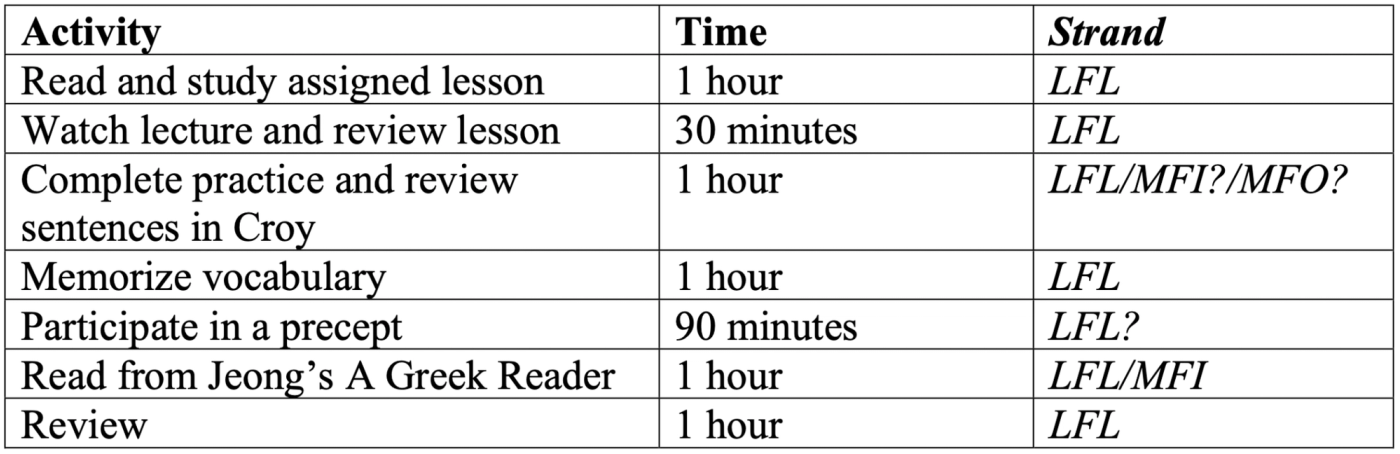
Even being as generous as possible to the diversity of activities, almost everything falls under the category of LFL, and this is consistent with the outcomes prescribed. Much time is spent learning about Greek, and very little time is spent using Greek. The practice and review sentences in Croy would normally be categorized as LFL exclusively since they involve translation, but because they are more “meaning-focused” (and in the spirit of generosity), we tentatively include those categories as well. Reading from Jeong’s A Greek Reader is a serious improvement, but even this may or may not fall into the category of MFI strictly speaking. In order to be MFI, over 95% of the vocabulary words should already be known, and attention must be given to comprehending the text rather than language features. Jeong’s book itself, though certainly a step in the right direction, includes grammatical notes, which would make at least that part of the text LFL. It is uncertain what would be done during a “precept,” but given the student outcomes, we have assumed it is LFL. This leads to the following breakdown of percent time for the four strands, with each activity with multiple strands being split evenly:

Students in this class will not be able to fluently read the Greek New Testament after the course is over. Reading Greek at any level will be a struggle. The course is not designed to teach them that skill, nor is that a stated desired outcome.
When we come to living language classrooms, I rely primarily upon my own experience as a student. I learned to speak Greek and Hebrew by taking classes both with the Biblical Language Center (BLC) and the Polis Institute, so I appreciate greatly what they are doing. Particularly at the Polis Institute, I learned the languages far better than when I took traditional seminary classes. While these programs are evolving and do differ from one another in several respects, there are fundamental similarities between the two. In both courses, the teacher will do the most talking in the classroom by far, which means that MFI will be the largest strand, probably amounting to 60-75%. In BLC, there is no discussion of paradigms, no explicit vocabulary learning, and no grammar discussion within the classroom itself—in other words LFL is essentially 0%. At the Polis Institute, grammar and vocabulary are discussed, but they are all done in the target language. This makes comprehension much more difficult (which we will discuss more fully below). Some MFO drills are done in pairs, but MFI still predominates. In the two years I took classes at either BLC or the Polis Institute, we never did a timed drill where attention was placed upon getting fast and fluent at language we already knew. This description leads to three primary issues: MFI being incomprehensible, lack of LFL, lack of fluency development.
The greatest advantage to these immersive programs is a very large quantity of input. Because the courses are “immersive,” input necessarily occurs. However, this input is comprehended at varying degrees by the students. In particular, I saw those with little language background struggle to understand much at all in the language classroom, and once a student gets behind, it is very difficult to catch up. If proficient students understand 95% of what is said to them, but a struggling student understands 50%, MFI is only occurring 50% of the time for the struggling student, while it is occurring 95% of the time for the proficient student. The result is that the stronger students get far more genuine comprehension practice than the weaker students. The problem is that strict immersion makes it very difficult for the instructor to be comprehended by everyone. Because the instructor must stay in the target language, more difficult words and grammatical concepts must be explained in the language itself with more sophisticated language, and this will often only be understood by the stronger students. Immersion guarantees input, but it does not guarantee meaning-focused input.
The second issue is the lack of LFL. While this neglect was more egregious in the BLC class I took, the total immersion hindered effective LFL in both settings. It was not infrequent that struggling students would approach the teacher after class and ask them questions (in English) about the grammar or vocabulary that was just explained in the previous 30 minutes. When the teacher would answer in English, they would take 2 minutes to explain the concept. If that 2-minute explanation was given before the concept was explained in Greek, the struggling students might have been able to follow the Greek explanation, making the input at least more comprehensible. The point is that the main benefit of LFL is to focus on language features, and if the student is not already quite proficient at the language, this may be difficult to accomplish in the target language. Hence, the common criticism of grammar-translation proponents that communicative teaching does not teach grammar or exegesis does have some merit.
Finally, although communicative methods are far more effective at producing fluent readers of the text (and speakers), little attention is normally paid to fluency activities. This does not mean that no automaticity develops, but because it is not an explicit focus, fluency often lags far behind comprehension. In my own experience, I could comprehend almost all of what was said in class, but I could still produce very little. It was not until I started practicing with basic language outside of class with a language partner that I started developing speaking fluency, and it was speaking fluency that helped me the most with reading fluency. Had I not engaged in this concentrated fluency practice with material I already knew, I would not have reached nearly the level of fluency I now possess (which can, of course, always be improved). More concentrated fluency practice in these courses would greatly facilitate long-term language development. On a more general level, while living language courses could be improved upon, they are far more effective than the GTM at language acquisition. On the other hand, GTM courses will normally result in students who can explain grammatical concepts at a more nuanced level than communication-based courses, even if such students will not have developed the language intuitions acquired by language use.
How does Biblingo fit into this picture? We see value in both approaches and allow you, the student, to decide which strand to focus on more. Different students have different goals, but we want to set our users up to read the Bible well. To accomplish this, we utilize production (MFO) as the most efficient means to language acquisition, and we balance this out with consistent reading on your level (MFI). Language features (LFL) are explained in the first language, so that concepts are understood better, and other more meaning-focused activities in the LFL strand stress deep engagement for maximum retention. Finally, timed reading and review allow for fluency development in both comprehension and production. Our typical lesson progression along with the strands for each activity can be seen in the below table. For each of the fluency drills, I note whether they fall under input (I), output (O), or a language-focused activity (L).
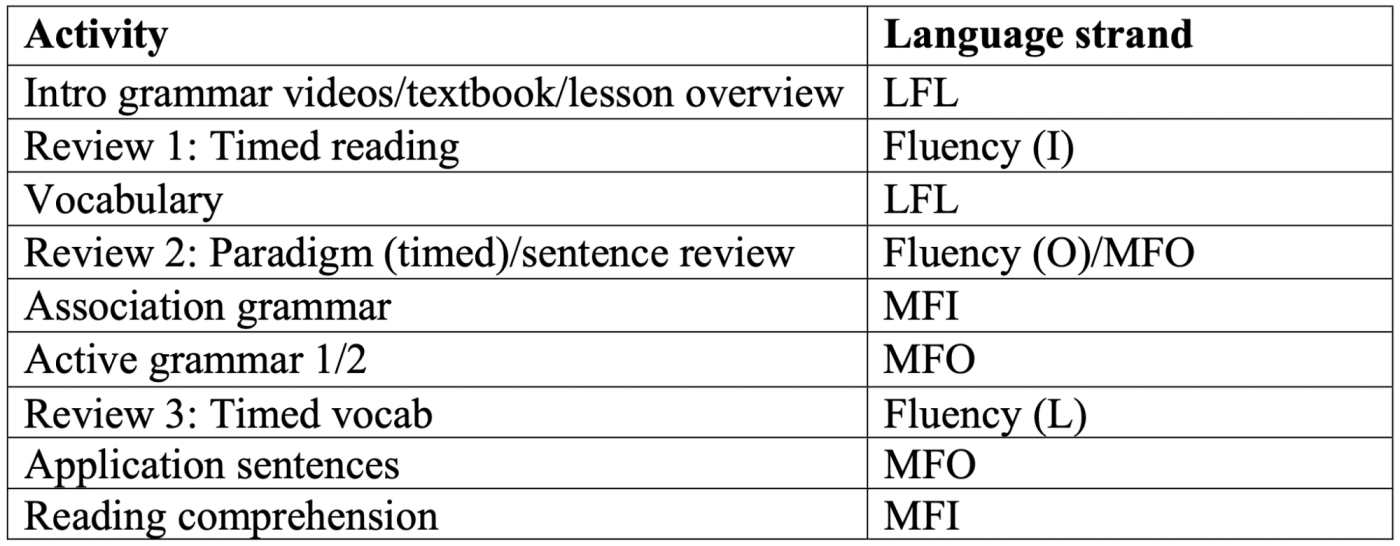
As you can see, our grammatical progression incorporates activities from all four strands in a fairly even distribution. How much time you spend on each strand will depend on the lesson and your goals, but the activities we provide give you the opportunity to have a balanced learning experience. Although there is a bent towards reading fluency, the program is flexible enough to accommodate other language goals as well. By following the progression, you should progress towards becoming a fluent exegete of New Testament Greek and/or Old Testament Hebrew.
Resources from Paul Nation
Here are several articles Paul Nation has written on this topic over the years: